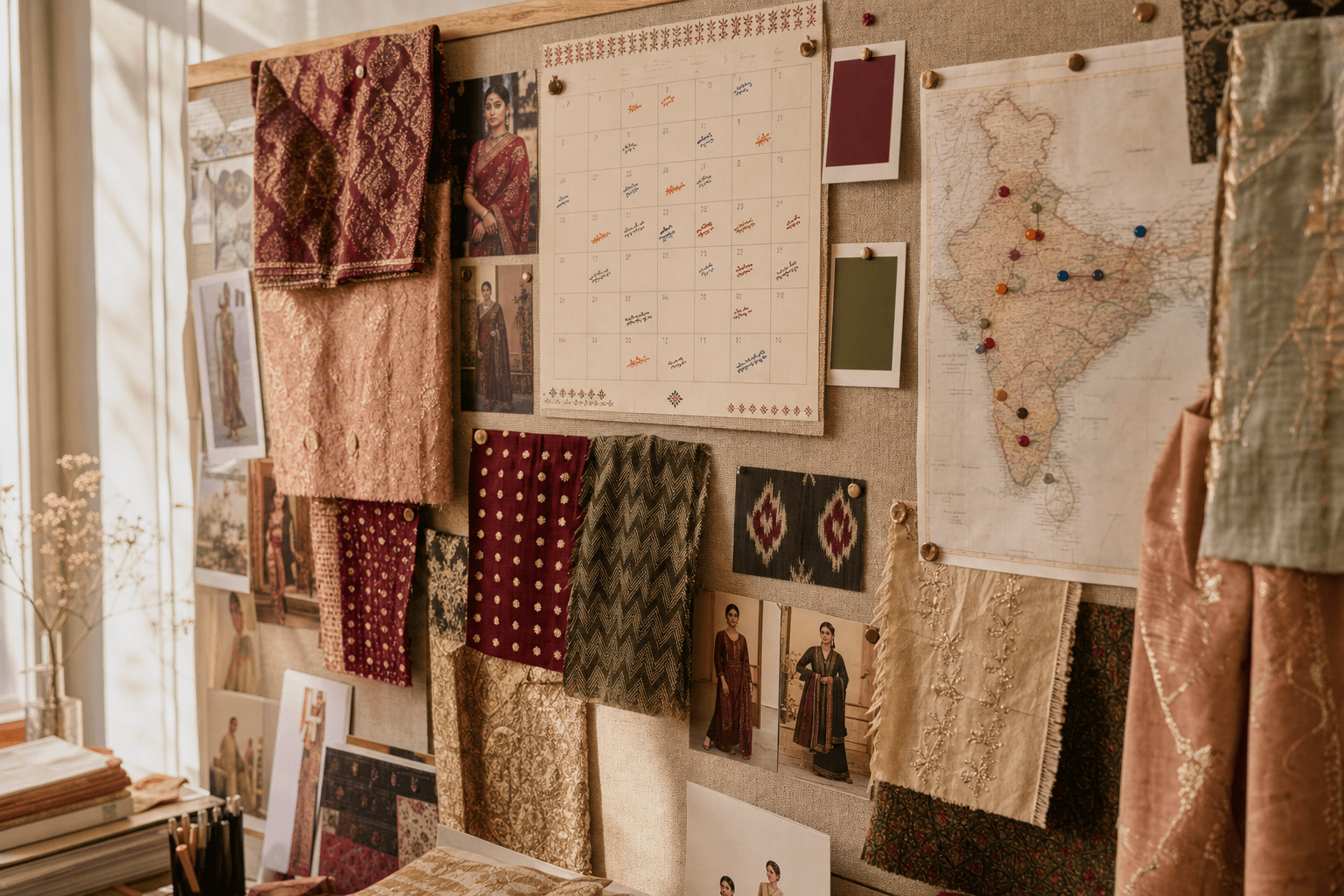
There is a story Indian D2C founders tell each other about WGSN.
A founder buys a seat in March, full of optimism. The platform is impressive — the user interface is clean, the trend reports are well-photographed, the global colour forecasts are issued with the gravitas of a meteorological bureau. The founder reads three reports, looks at the price tag converted from sterling, looks at the seat-based licensing, and quietly does not renew. The platform has not failed her. It has succeeded for the customer it was built for. The customer it was built for is not her.
This essay is about what a global trend platform structurally cannot see — and what an Indian buying floor sees every day. It is not a complaint about WGSN. It is an observation about category. The Indian D2C womenswear market needs its own intelligence layer because the signals that drive demand here are not the signals that drive demand in Milan.
Signal one: the calendar
The single largest difference between Indian fashion and the global market is the role of the calendar. Western fashion is loosely seasonal — spring, summer, autumn, winter — with two big retail events (Black Friday, Christmas) and a long tail of moderate festive lift. The seasonality is real but it is mild. A unit-level demand spike of two-and-a-half times the baseline is a notable event.
Indian fashion is calendar-driven in a way that has no Western equivalent. There are forty-two windows in a year that meaningfully shift demand for at least one category. The largest of them — Diwali, the wedding season, Karva Chauth, EOSS — produce category-level demand spikes of six to eight times the baseline. The smallest of them — regional festivals like Pongal, Bihu, Onam — still produce two-to-three times spikes in specific geographies for specific categories.
A Western trend platform will register Diwali as a date. Maybe a two-paragraph editorial. It will not bake a per-category lift coefficient into a forecast model, because the customer it was built for does not need that. The Indian buying floor needs that on every SKU, every week.
This is not a criticism. It is an architecture mismatch. You cannot retro-fit a calendar-aware demand model onto a platform built for continuous seasonality. The data structures are different. The training data is different. The customer expectation is different.
Signal two: regional fabric preferences
The second invisible signal is regional fabric preference. A buyer at a national D2C brand selling pan-India is, in practice, selling into eight or ten distinct fabric markets that prefer different textures, weights, and finishes for the same silhouette in the same season.
A cotton mul kurta moves in Tamil Nadu in summer; a chanderi-silk-blend kurta moves in Maharashtra in the same window for the same price point. A mukaish-worked dupatta is the wedding-guest default in Lucknow and the North; a zari-worked dupatta is the equivalent in Hyderabad and the Deccan. A chiffon saree is a Kolkata Pujo wardrobe staple; a tussar saree is the Bihar equivalent. The same brand selling on the same Shopify store will see these regional preferences as inscrutable noise unless someone is consciously modelling them.
A global trend platform models fabric at the level of the global runway — silk, cotton, denim, knit, linen. That is the resolution at which a European retailer needs to think. The Indian buyer needs the resolution to go three levels deeper. Banarasi is not a fabric, it is a philosophy. Chanderi is a different philosophy. Maheshwari is a third. Kanjeevaram and Patola and Bandhani and Kalamkari are not fabric varieties. They are lineages, with their own price elasticities, their own customer segments, their own festival affinities.
This is the kind of thing a national Indian buyer absorbs in her first three years on the floor and never has to think about again. It is also the kind of thing a global trend taxonomy cannot represent without giving up resolution that matters to its core customer.
Signal three: the wedding-guest sub-segment
The third signal — and this is the one most Western platforms miss most expensively — is the wedding-guest sub-segment.
Indian D2C womenswear is, for many brands, more than half wedding-guest. Not bridal, which is a separate and smaller market. Wedding-guest is the woman buying for her cousin's sangeet, her colleague's reception, her sister-in-law's mehendi. She is shopping for an occasion she is not the centre of. Her budget is meaningful but not unlimited. Her style preferences are specific — she wants to look photograph-good, not photograph-bridal — and her purchase window is tight, usually three to five weeks before the event.
The wedding-guest segment has its own demand cycle. It tracks the Hindu lunar calendar, regional auspicious dates, and a soft signal from the social-media ecosystem about what the bridal party is wearing. It is sensitive to runway in a particular way — the looks that move are not the headline bridal looks, but the second-row lehenga sets and the embellished kurta-shararas that the bride's family is wearing in the album.
A global trend platform does not have a category for this. It does not need one — the European market does not have a wedding-guest sub-segment of the same scale. The Indian platform that wants to be useful to a national D2C buyer has to.
“The looks that move in the wedding-guest segment are not the headline bridal looks. They are the second-row lehenga sets the bride's family is wearing in the album.
”
Signal four: the bellwether designers
The fourth signal is the role of a small handful of designers as bellwethers for the entire market.
In any given Couture or Lakmé Fashion Week, three or four designers will load a colour, a silhouette, or an embellishment that the wedding-guest market will adopt within two seasons. Sabyasachi is the largest of these. Anita Dongre is a second. Manish Malhotra is a third. There are five or six others — Tarun Tahiliani, Rahul Mishra, JJ Valaya, Anamika Khanna — who function as second-tier bellwethers for specific categories.
A buying floor with a sharp eye watches these designers obsessively. Every collection, every editorial, every social post. The pattern that emerges from a careful read is remarkably reliable: when Sabyasachi loads cobalt for a Couture collection, the wedding-guest market will be in cobalt within six to nine months.
The translation from runway to retail is not direct. The exact silhouette does not move; the colour does. The exact embellishment does not move; the family of embellishments does. A useful trend platform for the Indian market has to be reading the runway with this translation in mind — what colour family is loading, what silhouette family is loading, what embellishment family is loading — rather than tagging the literal look.
A global platform does not do this translation work because the European market does not need it. The runway-to-retail loop in Europe is faster and more direct, and the bellwether dynamic does not concentrate the way it does in India.
The taxonomy problem
All four of these signals share a common requirement. They need a taxonomy that respects how Indian buyers think.
Most demand-forecasting platforms — Indian or otherwise — operate on a generic apparel taxonomy. Dress, top, bottom, outerwear. Maybe a second level — A-line dress, midi dress, maxi dress. This is fine for fast-fashion in a Western market. It is useless for an Indian buyer who needs to know whether the demand spike she is seeing in kurta is for a cotton mul straight kurta with quarter sleeves or an embellished anarkali-style kurta with a cinched waist.
We hand-curated an Indian-specific taxonomy of two hundred and forty-seven attributes. Colour at the level Indian buyers actually use — maroon, marigold, pista, ivory, cobalt, terracotta — not the global Pantone abstractions. Fabric at the level of the lineage — chanderi, banarasi, maheshwari, mul, mulmul, tussar, organza, georgette — not the global fibre families. Silhouette at the level of the wardrobe — anarkali, sharara, palazzo set, co-ord, kaftan, kalamkari maxi — not the global dress categories. Embellishment at the level of the technique — zari, mukaish, gota, chikankari, kantha, kalamkari, block-print — not the global decoration types.
Two hundred and forty-seven is not a magic number. It is the number that emerged when we asked a working buyer to tag her own catalogue in a way that would let her ask the questions she actually has. The number could be larger. The number should not be much smaller. A platform that claims to forecast Indian D2C demand on a taxonomy of fifty attributes is not really doing the work.
Why this matters for the buyer
The cost of operating on a taxonomy that is too coarse is not theoretical. It is the eight-hundred-unit zari over-buy that should have been five hundred mukaish. It is the cobalt anarkali under-buy that walked out the door three weeks before the reorder window. It is the marigold cotton mul that was loaded for the wrong region and sold through at a fifty-percent markdown.
Every one of those errors is an error of taxonomy and signal. The buyer's instinct was right at the right level of resolution. The tool she had was wrong at a different level of resolution. The mismatch is what produces the markdown.
A trend intelligence platform built for the Indian market — built around the Indian calendar, the regional fabric preferences, the wedding-guest sub-segment, and the bellwether designer dynamic — is not a cheaper WGSN. It is a different category of product. It is the tool that lets the Indian buyer do the job she has been doing on instinct, at the resolution she has been doing it, with the maths to back her up.
That tool is what we set out to build. We are still building it. The buyers we work with are doing more of the right buys, more of the time, and the markdowns are getting smaller.
That is the only metric that matters.